



































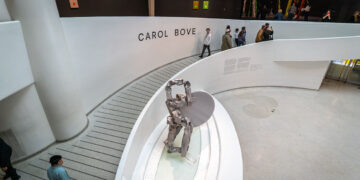




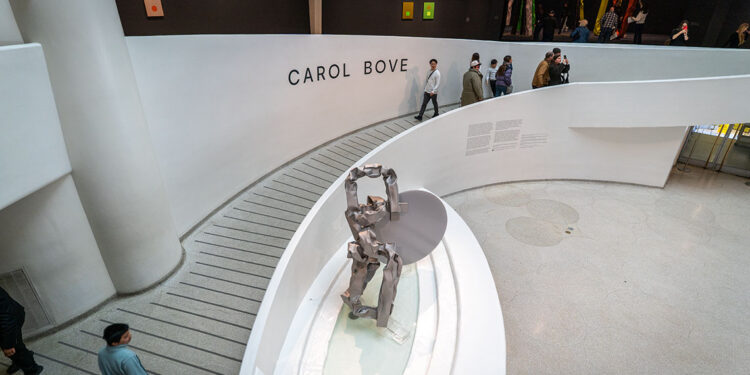
There is a specific kind of magic that happens when an artist finally stares down Frank Lloyd Wright’s rotunda and wins. For decades, the Guggenheim’s spiraling geometry has swallowed sculptors whole, turning their work into mere baubles on a very expensive shelf. But Carol Bove, in her sweeping new retrospective, hasn’t just occupied the space; she has recalibrated it.
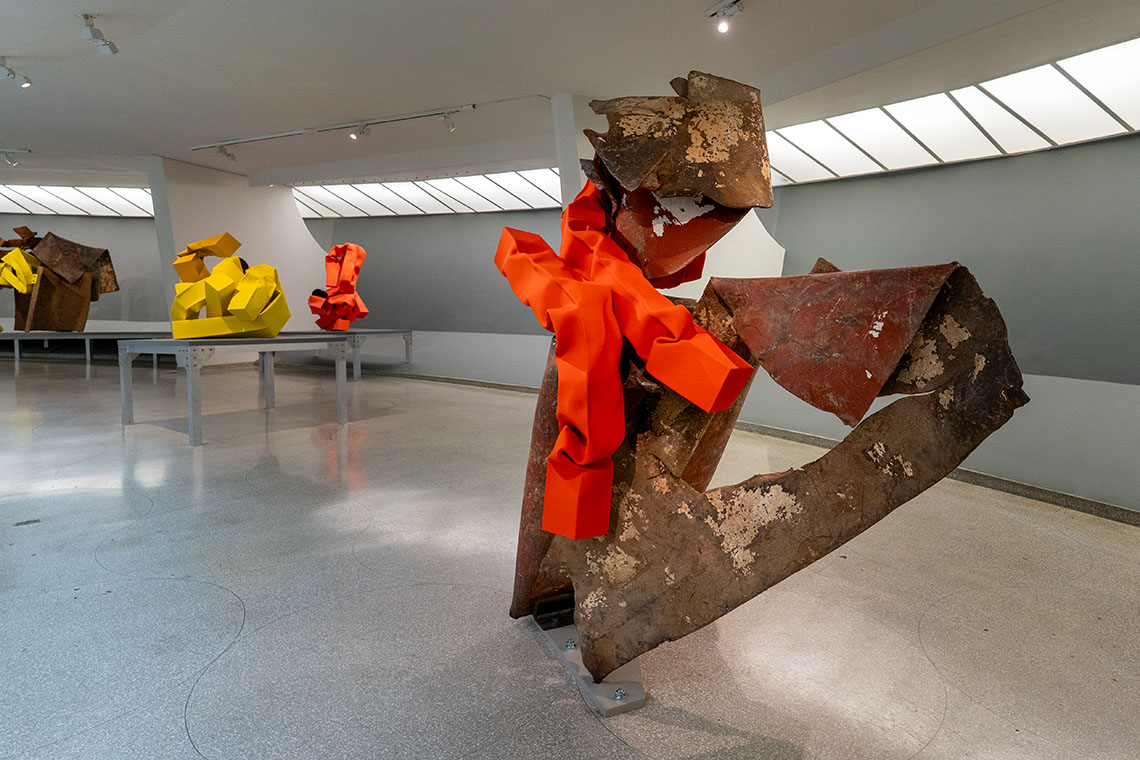
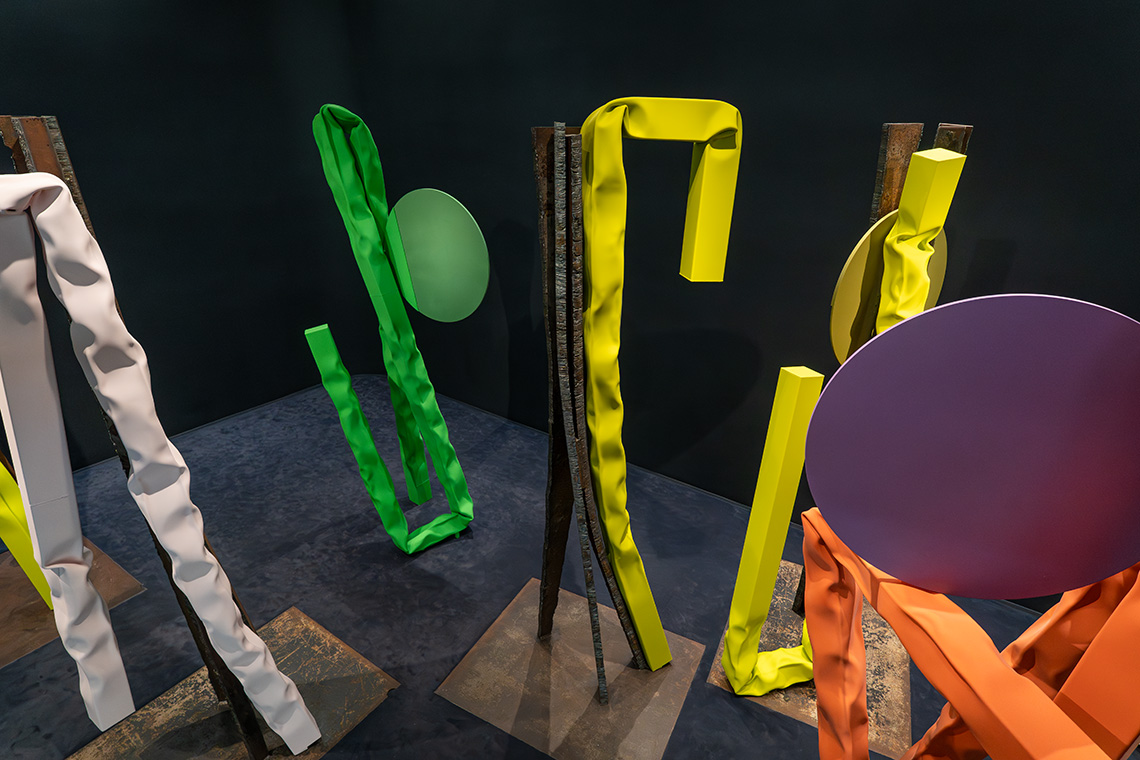
Walking into the museum this week, I was immediately confronted by Sweet Charity (2026) in the High Gallery. It is a thicket of towering, crumpled steel tubes, painted in defiant shades of ocher, chartreuse, and a particularly delicious citrus orange which look less like industrial refuse and more like giant, discarded candy wrappers. They are heavy, multi-ton monsters, yet they possess a “satin sheen” so convincing that I found myself resisting the urge to poke them just to see if they’d hiss and deflate.
A Journey in Reverse
The exhibition is cleverly staged in reverse chronological order. As you begin the ascent from the rotunda floor, you are essentially walking backward through Bove’s 25-year career. At the base, we see the “pipe monsters”, those massive, contorted stainless-steel compositions like Vase Face I / The Ascent to Heaven on a Dentist’s Chair. They feel almost biological, like the internal organs of some great mechanical beast that has been folded and tucked with the delicacy of origami.
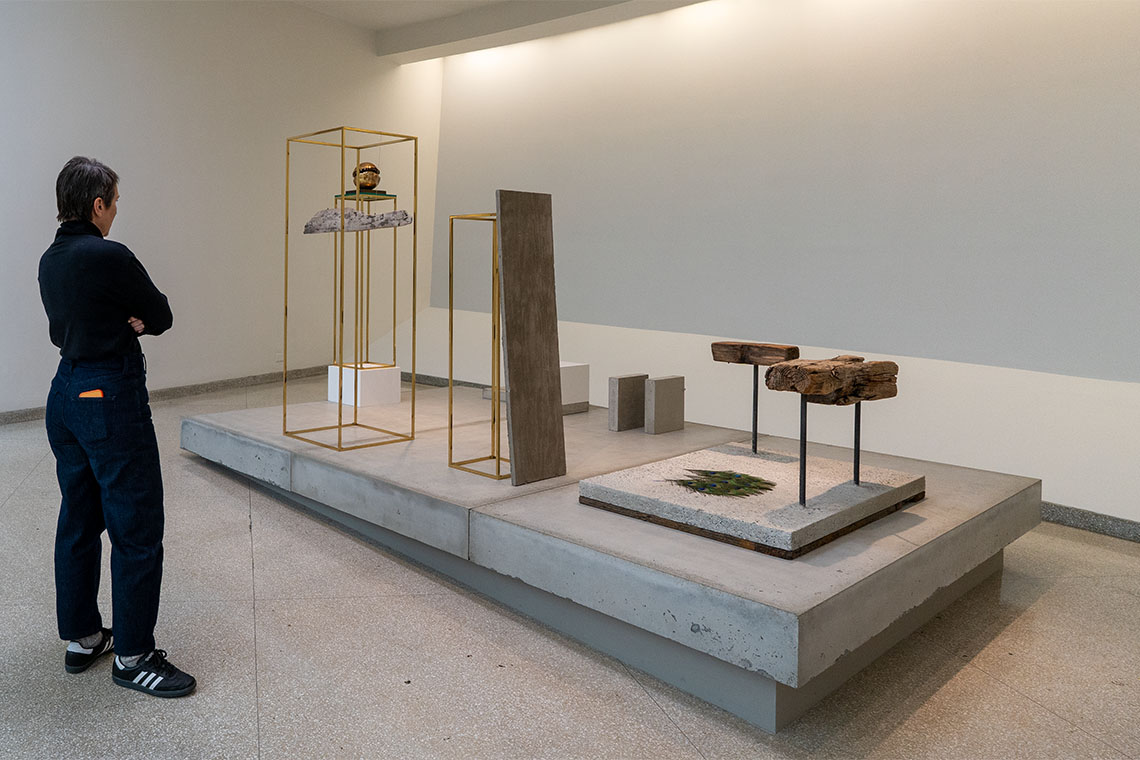
As I moved up the ramps, the scale shifted from the monumental to the intimate. Bove has always been a master of the “found object,” and the mid-level galleries remind us of her surgical precision. There are her famous bookshelf installations, like How People Get Power, where paperback books and driftwood are arranged with a balance so precarious it feels like a physical manifestation of a thought.
The Hidden and the Tactile
The most startling moment of the show, however, isn’t Bove’s own work, but what she chose to reveal. On Ramp One, Bove has cut a diamond-shaped aperture into the temporary wall to expose a piece of the museum’s own history: the Alicia mural by Joan Miró and Josep Llorens Artigas. Hidden for decades, the ceramic mural now peeps through Bove’s architecture, a secret shared between two artists across time.
Further up, on Ramp Two, the exhibition offers something strictly forbidden in almost every other corner of the art world: a Tactile Library.
“It’s a weirdly radical act,” I overheard a guard whisper as a teenager gleefully handled a heavy chunk of anodized aluminum.
In this space, you can touch the raw materials, the bronze, steel, and even peacock feathers used by Bove to construct her world. It demystifies the “sculptural titan” persona, bringing the work back down to the level of the hand and the tool.
The Verdict
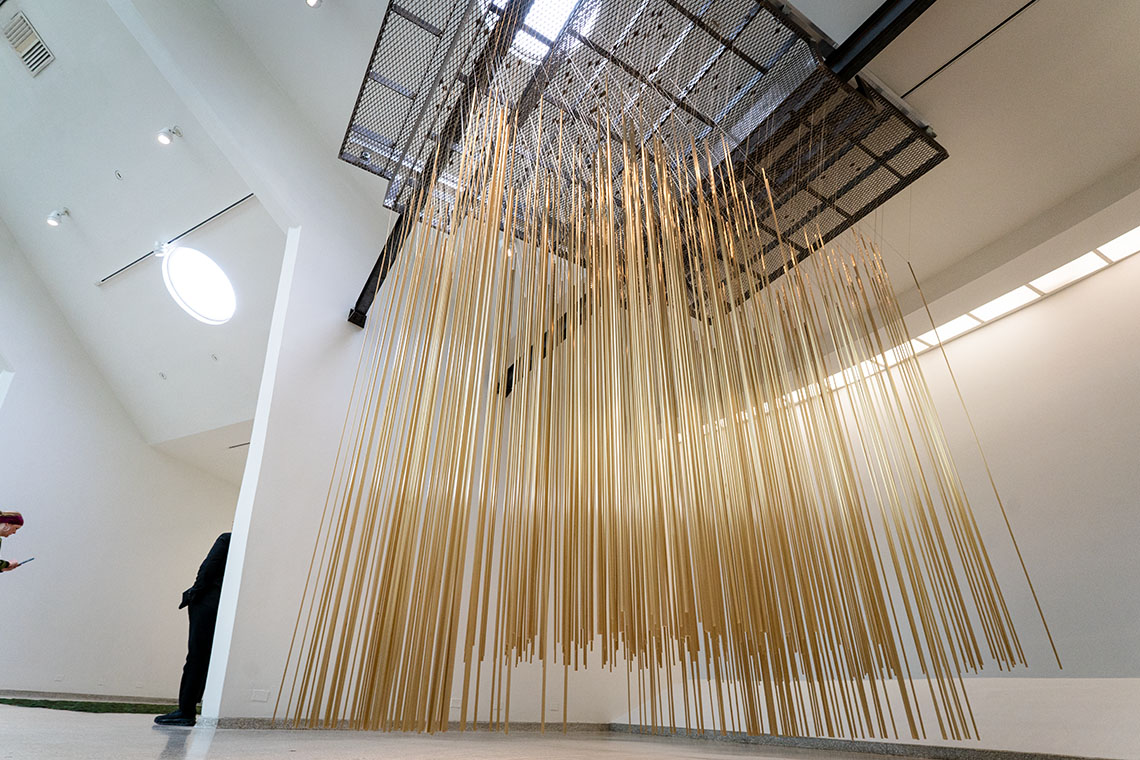
As I reached the top of the spiral, looking down at the six polished aluminum disks that Bove has hung to catch the light from the oculus, the museum felt different. Usually, the Guggenheim is a temple of looking; Bove has turned it into a laboratory of feeling.
She has taken the “hostile” reputation of heavy-metal minimalism and invited it to sit down and play a game of chess (literally, on artist-made tables scattered throughout the ramps).
By the time I reached the early drawings of nude models from the early 2000s near the top, the industrial weight of the ground floor felt like a distant, beautiful memory. Bove has managed to do the impossible: she has made steel feel as light as air, and the Guggenheim feel like home.