










































A federal judge in Manhattan on Wednesday cleared the way for what could be the largest mass refund in American trade history, ruling that the federal government must return billions of dollars in duties collected under President Trump’s now-defunct tariff regime.
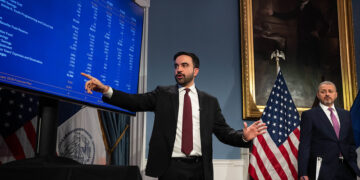
The decision by Judge Richard Eaton of the U.S. Court of International Trade provides the legal mechanism for a process the Supreme Court left unresolved last month. In his ruling, Judge Eaton declared that “all importers of record” are entitled to benefit from the high court’s finding that the administration’s use of emergency powers to bypass Congress was unconstitutional.
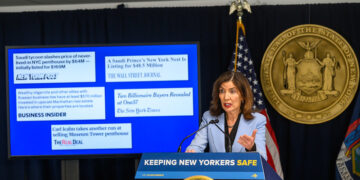
For Governor Kathy Hochul, who has spent weeks campaigning for a $13.5 billion “payout” for New Yorkers, the ruling is a pivotal victory.
Armed with new data and a favorable court order, Ms. Hochul moved beyond her previous requests for federal cooperation. She instead issued an ultimatum for the return of $13.5 billion she says was drained from the state’s economy.
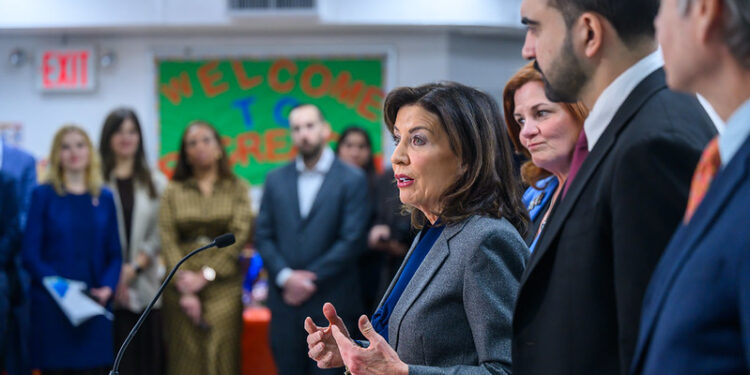
“I want New Yorkers to be reimbursed every single penny that they had to overpay because of this illegal scheme perpetrated by the Trump administration,” Ms. Hochul said, striking a podium in a gesture of uncharacteristic defiance. “The courts have spoken. The experts have spoken. Now it is time for the Treasury to open its checkbook.”
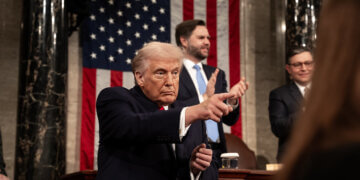
The legal battle stems from a series of double-digit import taxes President Trump imposed last year under the International Emergency Economic Powers Act, a move he dubbed “Liberation Day.” On February 20, the Supreme Court struck down the policy in a 6–3 ruling, but it did not provide a roadmap for how the Treasury should handle the roughly $175 billion collected nationwide.
Judge Eaton’s order now mandates that U.S. Customs and Border Protection stop collecting the duties and begin recalculating payments for goods currently in the federal accounting process.
A “Kick in the Teeth” for Consumers
The fiscal stakes for New York are particularly high. According to an analysis by the Budget Lab at Yale, the average household in the state has incurred approximately $1,751 in additional costs since the tariffs began on April 1, 2025.
Ms. Hochul has spent the last several days traveling across the state to highlight these costs, including a roundtable this week with farmers in Western New York. Many dairy and specialty crop growers reported that their annual operating expenses surged by $20,000, while exports of New York milk fell by 7 percent as trading partners retaliated.
“New York families have paid more for everything from groceries to Christmas presents,” the governor said. “To have this extra tariff thrown on them and their customers is just a kick in the teeth.”
The Importer’s Burden
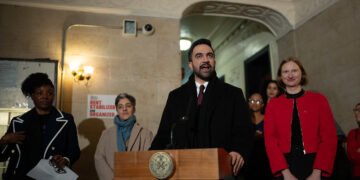
The litigation that led to this week’s ruling was spearheaded by small business owners like Victor Schwartz, the founder of VOS Selections, a wine and spirits importer in Manhattan. Mr. Schwartz, a lead plaintiff in the case that reached the Supreme Court, has emerged as a symbol of the commercial resistance to the administration’s trade war.
“If you are an administration that is trying to help businesses, then why shoot us in the foot?” Mr. Schwartz asked during a press conference with the governor. “The tariffs have been really painful. I see a lot of my colleagues in retail and in restaurants who have taken a big hit.”
A Defiant White House
The administration has remained unmoved by the rulings. Kush Desai, a spokesman for the White House, dismissed the Governor’s demand as a distraction from state level issues, characterizing the tariffs as a necessary tool for “rebuilding American industrial might.”
However, legal experts suggest the March 4 ruling from the Court of International Trade creates a massive administrative headache for the Treasury. Unlike the Supreme Court’s broad constitutional ruling, the trade court’s decision provides a specific mandate for U.S. Customs and Border Protection to stop collections and begin “reliquidating” entries.
The Governor’s use of the word “scheme” marks a notable shift in her approach to the White House. By framing the tariffs as an illegal extraction of wealth, she appears to be laying the groundwork for a class action style recovery effort.
As a stopgap, Ms. Hochul has proposed a $30 million relief fund for New York farmers as part of her 2026 executive budget. However, she emphasized that the state cannot fill the multibillion-dollar hole left by federal policy.
“I will never stop fighting for New Yorkers,” the governor said. “And that means staying focused on putting more money back in your pockets, not ripping it away.”