















































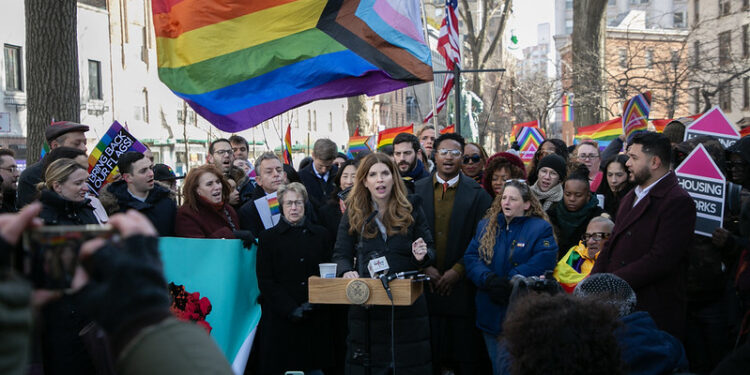
Standing in the cold shadow of the Stonewall Inn on Sunday, Senate Minority Leader Charles E. Schumer held aloft a rainbow flag, a symbol that has become the latest battleground in a widening cultural and legal rift between the city and the second Trump administration.
Mr. Schumer, flanked by local officials and veteran activists, announced the introduction of federal legislation designed to do what a decades-old movement once thought was settled: permanently protect the Pride flag at the Stonewall National Monument. The move follows a directive from the Department of the Interior last month that led to the flag’s quiet removal from federal parkland, sparking a week of defiance and protests in Greenwich Village.
“Stonewall is sacred ground,” Mr. Schumer said, his voice echoing across Christopher Park. “The Pride flag is not a decoration. It is a testament to a struggle that began right here. This legislation will ensure that no administration, now or in the future, can ever strip it away again.”
The bill, co-sponsored in the House by Representative Dan Goldman, Democrat of New York, seeks to designate the Pride flag as a “congressionally authorized symbol.” If passed, it would bypass the executive branch’s authority over federal flagpoles, codifying the rainbow banner’s right to fly alongside the Stars and Stripes at national monuments dedicated to L.G.B.T.Q. history.
A Policy of ‘Consistency’
The controversy began in earnest on Jan. 21, when the National Park Service issued a memo largely restricting the flags flown on its properties to the American flag, the Department of the Interior flag, and the POW/MIA flag. While the administration framed the move as an effort to ensure “consistency” and “neutrality” across federal lands, critics in New York saw it as a deliberate act of erasure.
By early February, the large rainbow flag at Stonewall had vanished. In its place, federal officials left only an empty lanyard on the flagpole that sits on federally managed land.
The removal followed a year of incremental shifts in how the administration handles the site. Since returning to office in 2025, the Trump administration has directed federal agencies to “remove improper ideology” from national memorials. At Stonewall, this resulted in the removal of the terms “transgender” and “bisexual” from the monument’s official website and the banning of the “Progress Pride” flag, which includes colors representing trans people and marginalized communities.
Defiance in the Village
The administration’s quiet retreat from the site’s symbolism was met with a loud response from New Yorkers. On Feb. 12, activists and local leaders gathered at Christopher Park to “re-raise” the flag in open defiance of the federal directive. As of Monday, the flag remains on the pole, maintained by a community that insists the monument belongs to the people who fought for it in 1969.
“You can actually see the footprints where, in the dark of night, park officials entered and removed the flag,” said Brad Hoylman-Sigal, the Manhattan Borough President. “Our history will not be erased by a memo from Washington.”
For the White House, the flag policy is part of a broader mandate to “restore truth and sanity” to the nation’s historical narrative. A spokesperson for the National Park Service stated that the agency would continue to “interpret the site’s historic significance through exhibits,” but maintained that non-agency flags “do not belong on federal poles.”
A Symbolic Uphill Battle
With Republicans controlling both the House and the Senate, Mr. Schumer’s legislation faces a steep climb. Yet for the Minority Leader, the bill is as much about political positioning as it is about preservation. By forcing a vote on the Pride flag, Democrats hope to draw a sharp contrast with the administration’s social agenda ahead of the 2026 midterms.
As the sun set over the West Village on Sunday, the rainbow flag continued to snap in the wind, just a few feet from the federal boundary where the dispute remains unresolved. For the activists who have spent their lives defending Stonewall, the piece of cloth has become a proxy for a much larger struggle.
“They think they can take down a flag and we’ll disappear,” said Ann Northrop, a long-time activist. “They haven’t been paying attention to what happened here fifty-seven years ago.”