









































When Zohran Mamdani launched his mayoral campaign, his platform was often dismissed by the city’s political establishment as a collection of idealistic slogans. He spoke of “class war,” of “foreclosing on the power of the landlord,” and of a city government that would aggressively intervene on behalf of the working poor.
Two weeks into his administration, the slogans have been replaced by subpoenas.
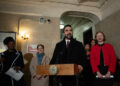
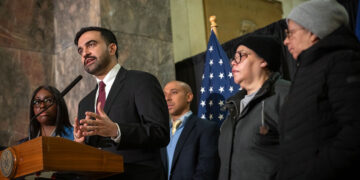
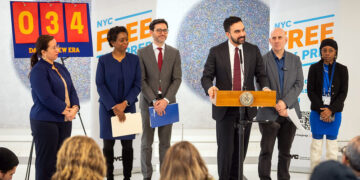
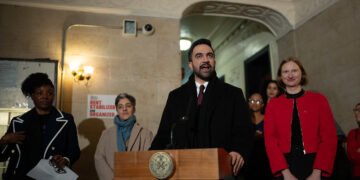
On Friday, Mayor Mamdani stood flanked by tenants and housing attorneys to announce a $2.1 million settlement with Apex Horizon Group, a mid-sized landlord accused of systematically harassing rent-stabilized tenants in Brooklyn and Queens to force vacancies. The agreement, which includes $1.5 million in restitution to tenants and $600,000 in civil penalties, represents the largest payout for tenant harassment in the history of the Mayor’s Office of Special Enforcement.
“For too long, the cost of breaking the law in this city was treated as a line item in a business budget,” Mr. Mamdani said, his voice echoing off the pillars of the City Hall rotunda. “Today, we are sending a new message. If you prey on everyday New Yorkers to inflate your profit margins, the city will not just fine you. We will make you pay back every cent you stole.”
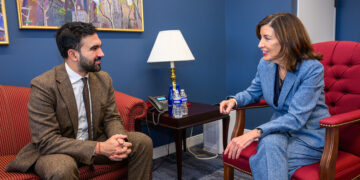
The settlement acts as an early, tangible proof of concept for the Mamdani administration. During the 2025 election, Mr. Mamdani, a Democratic Socialist, argued that existing laws to protect tenants were sufficient but suffered from a lack of political will to enforce them. He promised to weaponize the city’s bureaucracy, specifically the Department of Housing Preservation and Development (HPD) and the Office of Special Enforcement, to protect the “everyday New Yorker.”
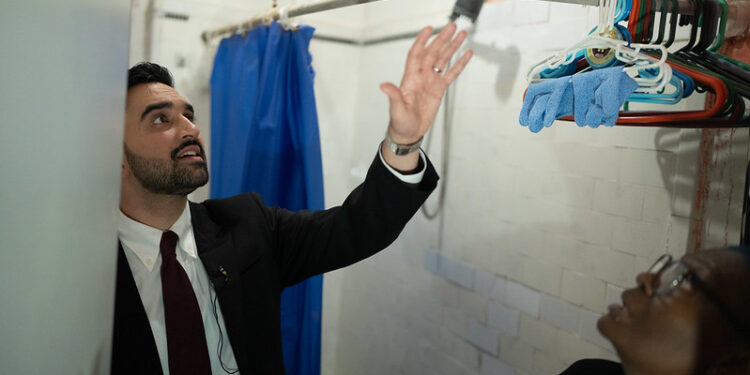
This case, which targeted a portfolio of 15 buildings in Bushwick and Corona, alleged a pattern of behavior that has become all too familiar in gentrifying neighborhoods. According to the complaint, the landlord engaged in “construction as harassment,” intentionally leaving common areas in disrepair, cutting off heat during winter months, and issuing frivolous eviction notices to long-term tenants paying below-market rents.
Under the terms of the settlement, Apex Horizon Group must not only pay the financial penalties but also accept independent oversight of its management practices for the next three years. Crucially, 45 apartments that had been unlawfully deregulated will be returned to rent stabilization, with their rents rolled back to 2020 levels.
For residents like Maria Rodriguez, a 62-year-old home health aide who has lived in her Bushwick apartment for two decades, the announcement was vindication after years of anxiety.
“We used to call 311 and feel like nobody was listening,” Ms. Rodriguez said, standing at the podium beside the Mayor. “They would send an inspector, write a ticket, and the landlord would just laugh. This time, nobody is laughing. This money means I don’t have to choose between medicine and rent this month.”
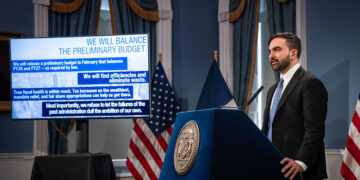
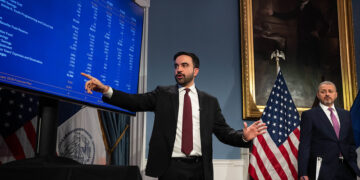
The settlement comes at a critical juncture. With the city facing a projected $2.2 billion budget shortfall, the Mamdani administration is under pressure to prove that its populist agenda can coexist with fiscal reality. By aggressively pursuing penalties from corporate bad actors, the Mayor is attempting to demonstrate a revenue stream that aligns with his ideology: funding the city by penalizing those he argues have exploited it.
However, the move has sent a chill through the real estate industry, which is already grappling with high interest rates and declining asset values. The Real Estate Board of New York (REBNY) issued a statement cautioning against a regulatory environment that prioritizes punishment over partnership.
“New York City needs more housing, and that requires private investment,” the statement read. “Treating property owners as adversaries rather than partners will only exacerbate the housing crisis and stall the development we desperately need.”
Yet, for the Mayor’s base, this conflict is a feature, not a bug. The Mamdani campaign was built on the premise that the interests of the real estate lobby and the interests of the working class are fundamentally at odds. By securing a record-breaking settlement in his first month, the Mayor is signaling that he intends to govern exactly as he campaigned.
The $2.1 million figure is, in the grand scheme of the city’s economy, a modest sum. But its symbolic weight is heavy. It suggests that the new administration views the law not as a neutral arbiter, but as a shield for the vulnerable.
“This is just the beginning,” Mr. Mamdani told the press as the event concluded. “We are reviewing every portfolio, every complaint, and every loop-hole. If you are a landlord doing right by your tenants, you have nothing to fear. But if you are building your business model on displacement, find a new line of work.”
For the everyday New Yorker, battered by the rising cost of living and the perennial fear of displacement, Friday’s announcement offered something rare in municipal politics: a sense that the city is finally fighting in their corner.