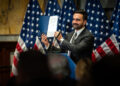










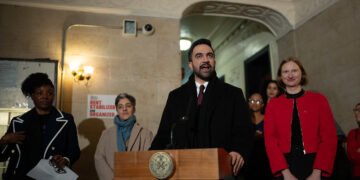
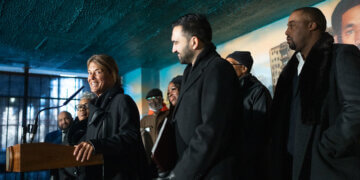


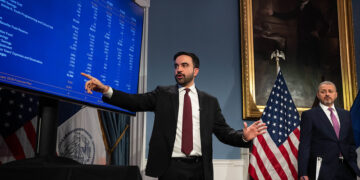
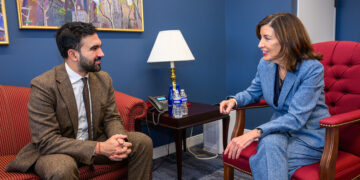














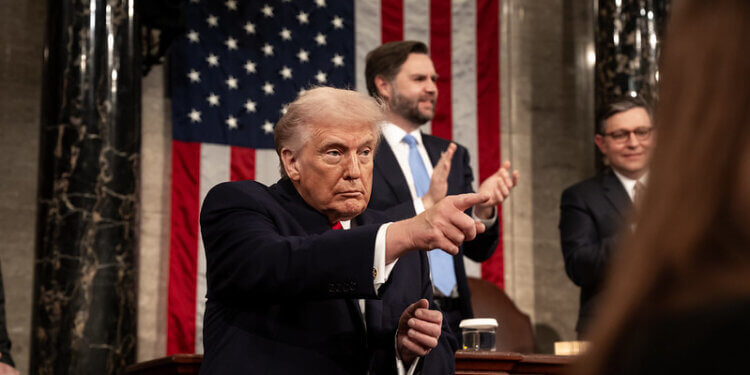
It was the kind of visual that only a year ago would have seemed like a fever dream of New York political theater. There, in the center of the Oval Office, stood Mayor Zohran Mamdani, a democratic socialist who once vowed to be the worst nightmare of Donald J. Trump, and the President himself, a man who once branded the Mayor a communist.
Between them, they held a mock up of a Daily News front page. The headline, a cheeky reversal of the darkest hour for the city in the 1970s, read: “Trump to City: Let Us Build.”
The surprise meeting on Thursday marked the most significant step yet in an emerging and surreal partnership between two men who share almost nothing in the way of ideology but everything in the way of a New York developer obsession with scale. At the heart of the discussion was a $21 billion pitch to transform Sunnyside Yard in Queens into a brand new neighborhood. This project would represent the largest federal investment in New York City housing since the era of Mitchell Lama.
A Rare and Massive Request
The proposal is as ambitious as it is expensive. Mayor Mamdani is seeking federal grants to construct a massive deck spanning 115 acres over the active Amtrak rail lines in Sunnyside. On top of that platform, the city envisions a metropolis within the city: 12,000 units of housing where every single one is restricted by income levels, alongside schools, parks, and health clinics.
For the Mayor, federal intervention is a mathematical necessity. “New York City is facing a generational affordability challenge,” Mr. Mamdani said following the meeting. “Working families are being priced out of the neighborhoods they built. To meet this moment, we need a true federal partner prepared to invest boldly and act urgently.”
The city simply cannot afford the cost alone. The decking of a rail yard, which is essentially creating land where none exists, is one of the most complex and costly engineering feats in urban planning. Without a massive infusion of federal cash, the Sunnyside Yard Master Plan, which has lingered in various stages of development since 2015, would remain a collection of glossy renderings.
The Oddest Couple
The political chemistry between the two men has baffled observers. President Trump, whose own real estate empire was built on the skyline of Manhattan, appears to have found a kindred spirit in the big build energy of Mamdani. During his recent State of the Union address, the President even referred to the Mayor as a nice guy, though one with what he called bad policies.
The partnership is rooted in a pragmatic compromise. For the President, the project offers a chance to leave a physical and architectural legacy in his home borough of Queens. For the Mayor, it is a chance to deliver on the central promise of his campaign which was housing for the working class.
“He asked me to come back with big ideas,” Mr. Mamdani told reporters, referring to a cordial meeting the two held in November. “I took him up on his offer.”
Beyond the Blueprint
While housing was the primary agenda, the meeting also touched on the ongoing friction of the city with federal authorities. Mr. Mamdani reportedly used the opportunity to advocate for several Columbia University students detained by federal agents during recent protests. Shortly after the meeting, one student, Elmina Aghayeva, was released. The office of the Mayor credited this to the direct intervention of the President.
Whether this enthusiasm from the Oval Office translates into a check for $21 billion remains to be seen. Skeptics point to the mercurial history of the President with federal funding for New York, including past threats to withhold funds from sanctuary cities.
Yet, as the two stood together on Thursday, the usual partisan vitriol was replaced by the language of the trade. For a moment, the socialist and the tycoon were just two New Yorkers talking about how to move a lot of dirt and pour a lot of concrete.