

















































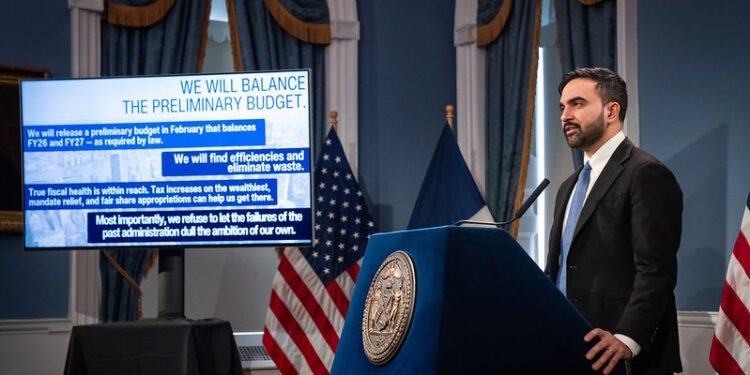
Moody’s Ratings on Wednesday revised the financial outlook for New York City to negative from stable, a cautionary move that highlights growing concerns over the city’s ability to balance its books despite a robust local economy.
While the agency affirmed the city’s primary Aa2 issuer rating, the shift to a negative outlook serves as a formal warning. Analysts pointed to “sizable and persistent” projected budget gaps that suggest a structural imbalance between what the city spends and what it brings in. This fiscal friction comes at a time when the city’s economic indicators, including employment and property values, remain remarkably strong.
“The negative outlook reflects the emergence of sizable and persistent projected budget gaps that signal underlying structural imbalance and reduced financial flexibility,” the agency stated in its report.
The report paints a picture of a city at a crossroads. On one hand, New York remains a global titan with a $1.1 trillion economy that is larger than all but four states. Its population of roughly 8.48 million people supports a labor force and a tax base that Moody’s described as a “substantial credit strength.” On the other hand, the city’s vast operational responsibilities—which include the nation’s largest public school system and five separate counties—are increasingly straining its long term financial planning.
Moody’s also affirmed ratings for several specific classes of debt, including:
- Aa2 for general obligation bonds.
- Aa1 for future tax secured bonds issued through the Transitional Finance Authority (TFA), reflecting strong protections for investors.
- Aa2 for Hudson Yards Infrastructure Corporation revenue bonds.
- Aa3 for various appropriation backed bonds, including those for the Health and Hospitals Corporation.
The ratings agency noted that while New York City has historically used disciplined budget practices to navigate crises, the current projections for future deficits are troubling. Over the next year, Moody’s will monitor whether the city can narrow these gaps through recurring measures rather than relying on one time fixes or dipping into reserves.
The path back to a stable outlook is clear but difficult. Moody’s indicated that an upgrade or stabilization would require the maintenance of sustainable budgets and a reduction in the city’s fixed cost ratio. Conversely, if budget gaps grow to nearly 10 percent of city revenue, or if the city returns to a negative fund balance, a formal rating downgrade could follow.
For now, the Aa2 rating remains supported by the city’s “global financial and cultural prominence” and its ability to generate revenue across economic cycles. However, the negative outlook suggests that even the most powerful economic engine in the country cannot indefinitely outrun a structural deficit.