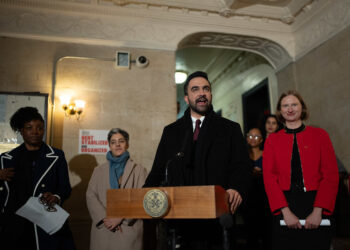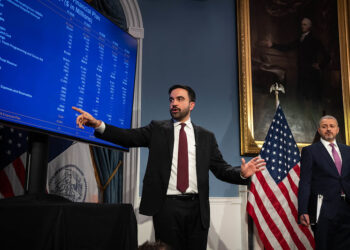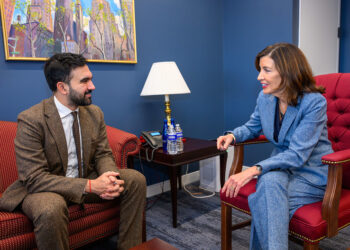
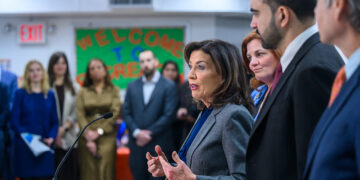

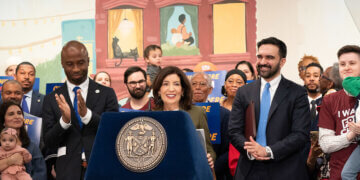










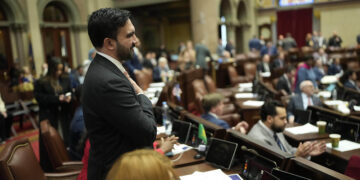





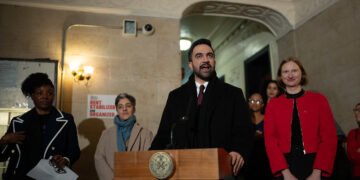






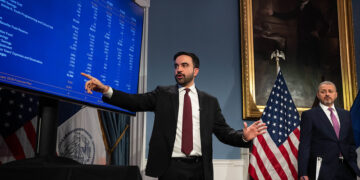
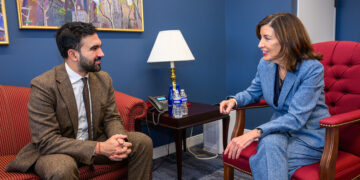

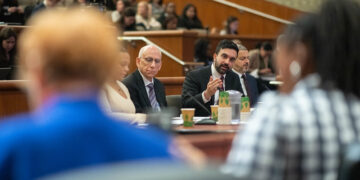



















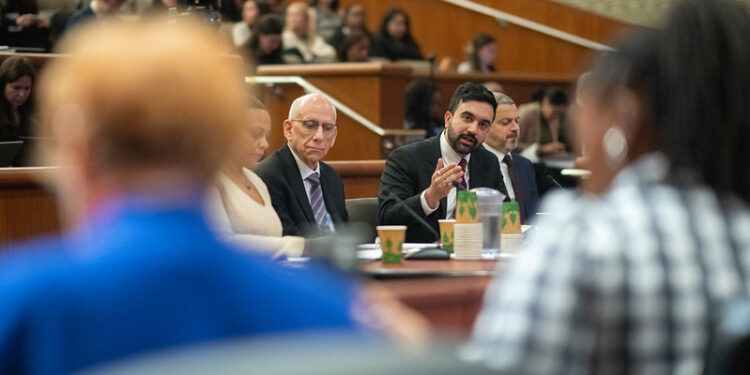
Mayor Zohran Mamdani used his appearance at the Joint Legislative Budget Hearing on Tuesday to deliver a sweeping argument for reshaping New York City’s finances and its relationship with the state, urging lawmakers to approve tax increases on corporations and millionaires while framing the city’s fiscal troubles as the result of his predecessor’s decisions.
In prepared remarks that blended fiscal alarm with political ambition, Mr. Mamdani said New York City is confronting a multibillion dollar budget gap, recently revised from roughly $12 billion to about $7 billion after updated revenue forecasts, savings measures and the use of reserves. He labeled the shortfall the Adams Budget Crisis, accusing former Mayor Eric Adams of underbudgeting major programs such as rental assistance, cash assistance and homeless shelters.
But the mayor’s central message was directed less at City Hall’s past than at Albany’s present.
Calling for a new era of partnership between the city and state, Mr. Mamdani argued that New York City contributes disproportionately to state coffers, about 54.5 percent of revenues, while receiving back closer to 40.5 percent. That imbalance, he contended, has strained city services for years, particularly in public health, foster care and assistance for low income families.
To close the remaining deficit, Mr. Mamdani proposed recurring revenue measures that would require state approval, including raising the corporate tax rate and increasing personal income taxes by 2 percentage points on New Yorkers earning more than $1 million annually. Someone earning $1 million, he said, could afford roughly $20,000 more in taxes each year. The surcharge, he argued, could close nearly half of the city’s projected gap.
Those proposals are likely to test the limits of Governor Kathy Hochul’s political coalition.
Ms. Hochul has sought to balance progressive priorities with concerns from business leaders and moderate Democrats wary of prompting high earners and corporations to relocate. While she has supported targeted tax credits and social spending, broad based increases on top earners and corporations could face resistance from suburban lawmakers and business groups who argue that New York is already one of the nation’s highest tax states.
Mr. Mamdani’s call to raise corporate taxes arrives at a moment when state leaders have emphasized competitiveness and economic stability. Critics are likely to argue that such increases could dampen investment or accelerate outmigration among financial firms and wealthy residents, a recurring concern since the pandemic.
The mayor also endorsed reforms to the State Environmental Quality Review Act to accelerate housing development, a move that could divide environmental advocates and lawmakers protective of local control. While housing production has broad support in principle, previous attempts to streamline environmental review have prompted debate over community input and oversight.
On education, Mr. Mamdani backed a four year extension of mayoral accountability over New York City schools, a governance structure that requires periodic state renewal and has historically prompted negotiations between City Hall and Albany.
He also signaled support for making city buses fast and free as part of a broader affordability agenda that would require sustained funding and coordination with the Metropolitan Transportation Authority, a state controlled entity. Free transit proposals have drawn praise from transit advocates but skepticism from fiscal watchdogs who question long term funding sources.
At the same time, Mr. Mamdani praised Ms. Hochul for her support of universal child care and for backing an enhanced child and dependent care tax credit. He pointed to a $1.2 billion state commitment toward universal child care as evidence that city state cooperation can produce tangible results. Universal child care, he said, would improve educational outcomes, boost workforce participation and make New York more affordable for families.
The mayor also highlighted early steps taken by his administration, including expanding supportive housing, investing in public infrastructure, protecting tenants and securing multimillion dollar settlements from landlords accused of deceptive practices.
Throughout his remarks, Mr. Mamdani framed his agenda as a departure from austerity. Rather than cutting services, he argued for raising revenue from those most able to pay and correcting what he described as structural inequities between the city and state.
For Ms. Hochul, the calculus may prove delicate. Aligning too closely with the mayor’s tax proposals could expose her to criticism from business leaders and political opponents who warn of economic fallout. Rejecting them outright, however, could strain relations with the city’s new administration at a time when cooperation is needed on housing, transit and education.
By the end of his testimony, Mr. Mamdani struck a conciliatory tone, thanking lawmakers and expressing optimism about collaboration. Yet his proposals, particularly the call to raise taxes on corporations and millionaires, ensure that the coming budget negotiations will test whether the new era of partnership he envisions can withstand the political realities of Albany.