




















































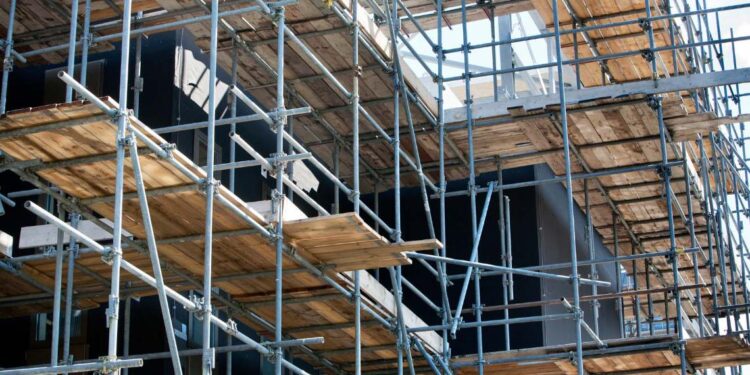
Standing next to the plywood canopy of a Bronx public housing complex on Friday, Mayor Zohran Mamdani announced a series of aggressive new measures intended to strip away the miles of sidewalk sheds that have long obscured the city’s storefronts and streets.
The plan, unveiled at Highbridge Gardens on the 65th day of the mayor’s term, targets the roughly 380 miles of scaffolding that currently encase thousands of city blocks. It represents a significant escalation in a decades long struggle by City Hall to reclaim sidewalks from the ubiquitous green structures that many New Yorkers view as a permanent blight.
“In the greatest city in the world, we should not accept darkened sidewalks and covered walkways as a fact of life,” Mr. Mamdani said as city workers behind him began dismantling a shed that had stood at the complex for five years. “No New Yorker should have to go about their day under corrugated tin and plywood simply because their landlord would rather shirk their responsibilities than fix what needs fixing.”
A Strategy of Penalties and Progress
The centerpiece of the administration’s strategy is a set of new Department of Buildings rules that will penalize property owners who leave sheds in place for more than 180 days without beginning facade repairs. Under the proposal, landlords could face steep monthly fines and will be required to provide the city with progress updates every 90 days.
In a move to reduce the number of sheds erected in the first place, the city will also overhaul its facade inspection cycles. For buildings considered low risk and well maintained, the current five year inspection requirement will be extended to 12 years. Other eligible buildings will see their cycles move from five to six years.
The reforms also seek to limit the physical footprint of the structures. New regulations will restrict sheds to a maximum of 40 feet from a building facade, preventing them from swallowing up open spaces on large campuses like those operated by the New York City Housing Authority.
“Sheds may seem small, but they are a big imposition on New Yorkers’ quality of life,” said Leila Bozorg, the deputy mayor for housing and planning.
The Toll of Scaffolding
There are currently 7,859 sidewalk sheds across the five boroughs, according to city data. While most are installed for legitimate safety reasons during construction, more than 370 of them have remained in place for more than five years, often because owners find it cheaper to pay for shed permits than to fund expensive structural repairs.
At Highbridge Gardens, the removal of 2,800 linear feet of scaffolding was made possible by $14.4 million in state funding. The complex is part of a broader $650 million initiative involving state and federal funds to address facade repairs at 40 NYCHA developments citywide.
Buildings Commissioner Ahmed Tigani noted that the city has already seen a 17 percent decline in the total number of sidewalk sheds through earlier efforts. He described the new rules as a way to build on that momentum by giving the city stronger tools for oversight.
“The removal of shedding at Highbridge Gardens signifies safer conditions and clearer walkways,” said Lisa Bova-Hiatt, the chief executive of NYCHA.
The new enforcement procedures and oversight measures are expected to go into effect this summer.