
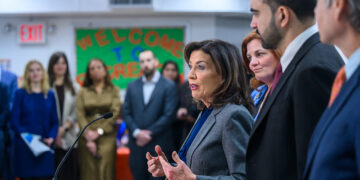

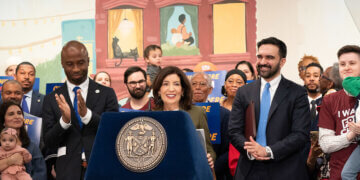








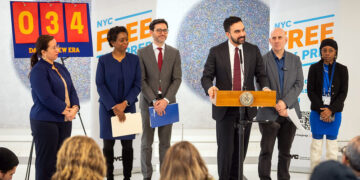





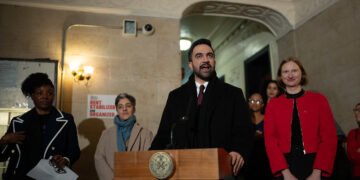

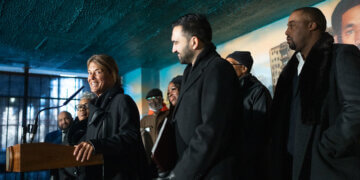


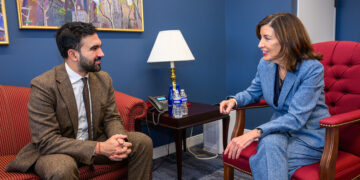
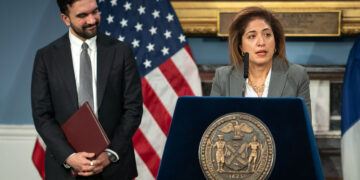
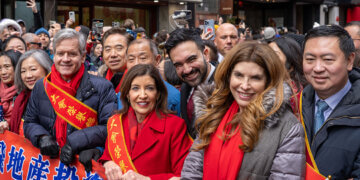











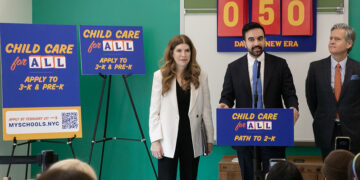





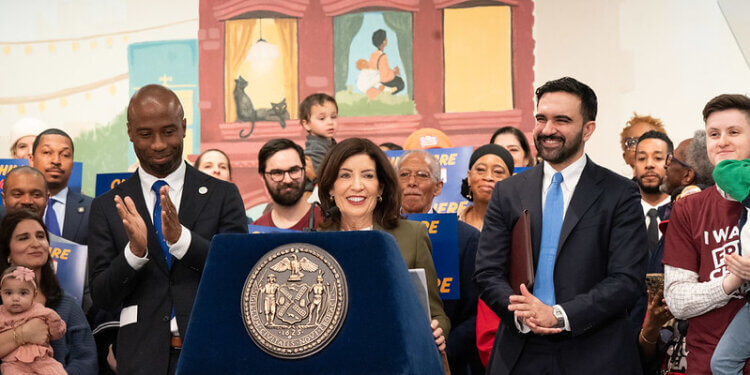
Governor Kathy Hochul and Mayor Zohran Mamdani stood together in a Brooklyn community center on Tuesday to announce a significant expansion of the city social safety net. The leaders unveiled the first phase of a program that will eventually provide free child care for every two year old in the five boroughs, a move that signals a rare moment of policy alignment between the centrist governor and the democratic socialist mayor.
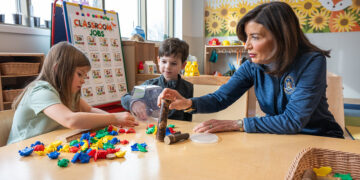
The initiative, known as 2-K, will launch this fall with 2,000 seats distributed across four high need communities. The selection of these initial neighborhoods which are Washington Heights and Inwood in Manhattan, Fordham and Kingsbridge in the Bronx, East Brooklyn, and the Ozone Park and Rockaways area in Queens, reflects a strategy to prioritize families in districts where the gap between child care demand and available supply is most severe.
A Shared Vision for the Care Economy
For Governor Hochul, the partnership is an extension of her multiyear effort to stabilize the state workforce and provide relief to middle class families. Since taking office, she has overseen billions of dollars in investments toward child care infrastructure, often framing the issue as a cornerstone of economic recovery. By fully funding the first two years of the city rollout with state revenue, she is doubling down on the belief that affordable care is a prerequisite for a thriving New York.
Mayor Mamdani, who made universal child care a centerpiece of his insurgent mayoral campaign, sees the milestone as a victory for the principle of care as a public right. Unlike previous programs that relied on complex voucher systems or income caps, the 2-K program is designed to be universal. Any parent living within the selected school districts can apply, regardless of their income or immigration status.
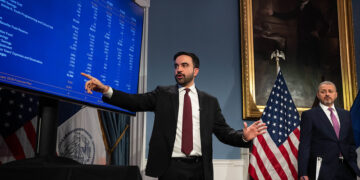
“This is about more than just a budget line,” Mr. Mamdani said during the announcement. “It is about ensuring that every New Yorker can afford a life of dignity and that the cost of raising a child is no longer a barrier to staying in this city.”
The Road to Universality
The announcement marks the first major deliverable of the Mamdani administration, which is nearing its first 100 days. While the initial 2,000 seats represent only a fraction of the city toddler population, the administration plans to scale the program rapidly.
| Phase | Target Number of Seats | Timeline |
| Phase 1 | 2,000 Seats | Fall 2026 |
| Phase 2 | 12,000 Seats | Fall 2027 |
| Full Rollout | ~55,000 Seats | by 2030 |
The state has committed $73 million for the first year of implementation, with that figure expected to rise to $425 million as the program expands. To meet the demand, the city will rely on a network of existing child care centers and family based providers rather than building new classrooms within public schools. This approach aims to support the small businesses and community organizations that already form the backbone of the city care system.
Background and Context
New York has long been one of the most expensive places in the nation to raise a child, with many families spending more than a third of their income on care for infants and toddlers. While the city universal prekindergarten and 3-K programs offered relief for older children, the “care gap” for those under age three remained a persistent challenge for working parents.
The 2-K initiative seeks to close that gap by “aging down” the existing preschool model. By 2028, the state also aims to achieve universal prekindergarten for all four year olds across the entire state, ensuring that the path from infancy to elementary school is fully supported by public funding.
Critics of the plan have raised concerns about the long term sustainability of such a massive entitlement. However, Ms. Hochul emphasized that the state can fund the program through existing revenue streams, citing a well managed budget and a commitment to avoid new taxes for this specific expansion.
As the application process for the first seats opens this summer, the eyes of the nation will likely be on New York. The success of this experiment could provide a blueprint for other states and cities looking to treat child care not as a private luxury, but as a public good.