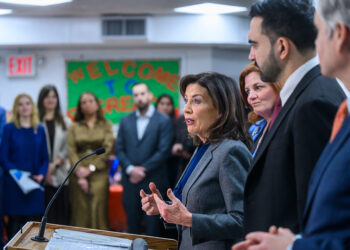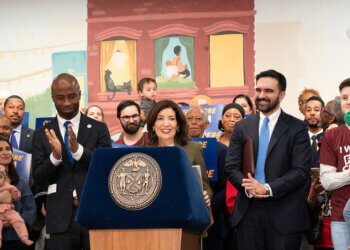
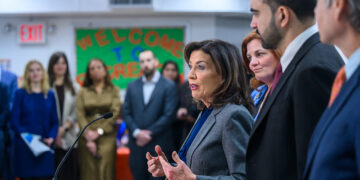
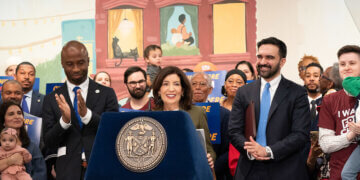
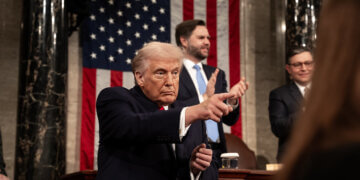






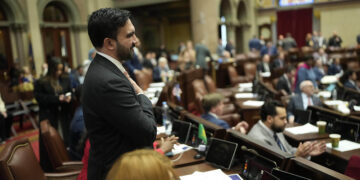




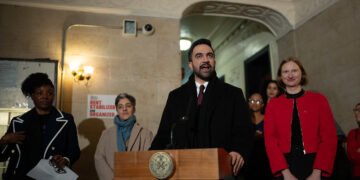

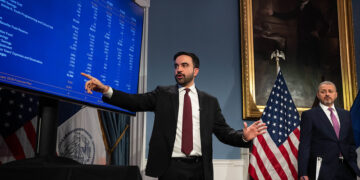
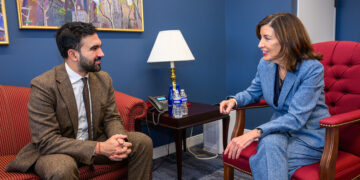
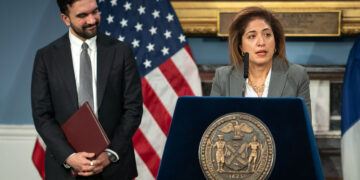

















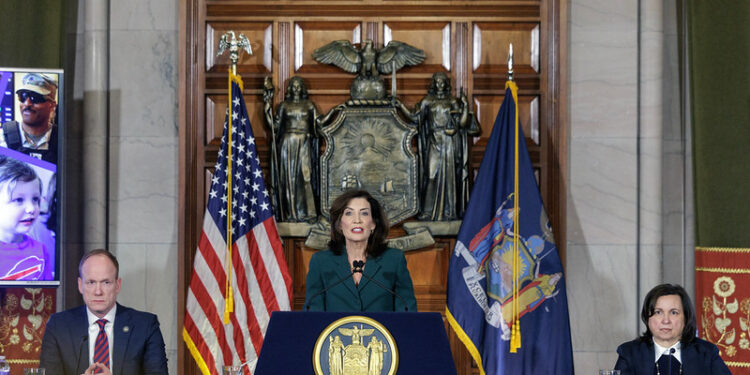
Governor Hochul presented her executive budget for 2027 on Tuesday, outlining a $239 billion spending plan that seeks to walk a tightrope between fiscal prudence and aggressive social investment. Under the banner of “Stronger, Safer, More Affordable,” the Governor detailed a vision that avoids broad increases in personal income taxes while directing significant resources toward housing supply, mental health services, and a continued, forceful police presence in New York City’s transit system.
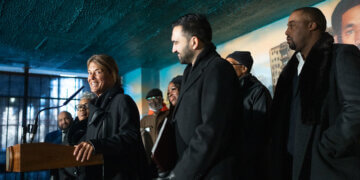
The presentation in the Red Room at the State Capitol served as the opening move in what promises to be a contentious three-month negotiation with the State Legislature. With New York City facing its own severe budget deficits and a new socialist administration in City Hall under Mayor Zohran Mamdani, Governor Hochul attempted to position herself as the adult in the room by offering stability and increased funding in a time of political flux.
A “Surge” on the Subways
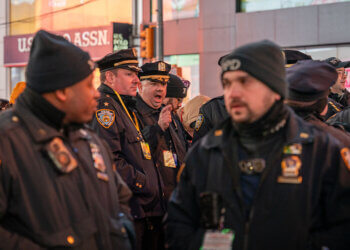
The most distinct and potentially controversial pillar of the Governor’s plan is her continued focus on “Enhance Subway Safety.” Despite the changing political winds in City Hall, Hochul is doubling down on the policing strategies that defined the latter half of her previous term.
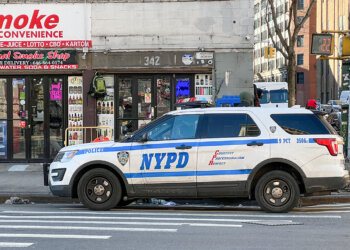
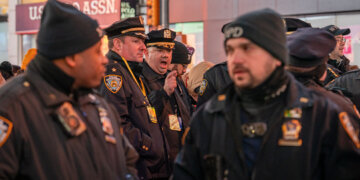
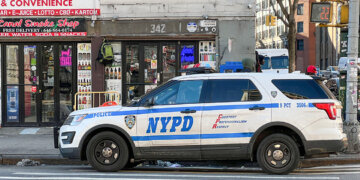
The Executive Budget allocates a specific $77 million investment to partner with New York City to maintain an increased police presence on platforms and trains. This funding is designed to support “temporarily surging patrol levels,” effectively subsidizing the overtime costs required to keep uniformed officers visible in the subway system.
In her remarks, the Governor touted the efficacy of this strategy. “Since taking office, we have invested more than $122 million in subway safety,” Hochul stated, referencing the cumulative state support for the NYPD’s transit operations. The administration points to data indicating that these investments have “reduced summer transit crimes to historic lows,” a statistic the Governor used to justify the continued expenditure.
This provision places Governor Hochul on a potential collision course with Mayor Mamdani’s base. While the new Mayor has campaigned on shifting resources away from traditional policing toward social services, the Governor’s budget essentially earmarks state aid for the express purpose of policing. By funding the “surge” directly, Hochul is ensuring that the visual deterrence of officers in the transit system remains a fixture, regardless of the ideological preferences of the City Council or the new administration.
The safety plan extends beyond the turnstiles. The Governor also proposed $40 million to expand the State Police Community Stabilization Units and dedicated funding to combat retail theft, a persistent complaint from business owners that has become a political liability for Democrats. Additionally, she proposed a $300 million investment to strengthen the interplay between mental health services and the criminal justice system, aiming to treat the severe mental illness that often drives recidivism and random acts of violence in public spaces.
The Housing Push: Supply Over Subsidies
Perhaps the most ambitious component of the budget is the “More Affordable” plank, which focuses almost exclusively on housing supply. Stung by the legislature’s rejection of her housing compact two years ago, Hochul is back with a modified, incentive-based approach.
The FY 2027 budget includes tax incentives for developers to convert vacant commercial office space into residential units, particularly in Manhattan’s struggling business districts. Crucially, it proposes a successor to the expired 421a tax break which is a move she argues is essential for spurring rental construction. This is likely to face fierce opposition from progressive lawmakers who view such incentives as giveaways to developers. However, Hochul remained firm: “We cannot solve the affordability crisis by wishing for lower rents. We must build our way out of it.”
Impact on New York City: A Lifeline, Not a Bailout
For New York City, the Governor’s budget is a mixed bag that highlights the growing tension between Albany and City Hall. The most critical lifeline is the continued state assumption of costs related to the migrant crisis. The budget allocates $2.4 billion to assist the city with shelter, legal services, and case management for asylum seekers. This is a significant sum, yet it falls short of the full reimbursement that Mayor Mamdani and Comptroller Mark Levine have requested to plug the city’s widening deficits.
Notably, while the city faces a projected $10.4 billion deficit, Governor Hochul did not offer a bailout for the city’s general operating budget. Her message to the new administration seems to be that the state will help with humanitarian emergencies like the migrant crisis and with shared priorities like subway safety, but the city must manage its own operational ledger.
The budget also maintains the stability of the Metropolitan Transportation Authority (MTA). Thanks to the payroll mobility tax increase passed previously, the MTA is not facing a fiscal cliff this year. However, the Governor resisted calls to freeze fares, meaning subway and bus riders could see another 4 percent hike in 2027, a move that will hit working-class commuters hardest.
How New Yorkers Are Affected
For the everyday New Yorker, the budget offers protection from new taxes but little in the way of immediate cash relief. There are no new broad-based tax hikes, which will come as a relief to suburban homeowners and middle-class families worried about the state’s competitiveness.
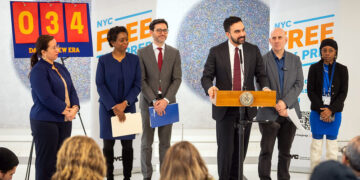
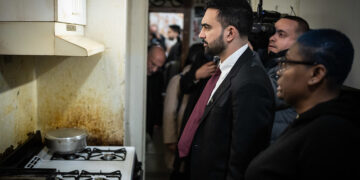
Parents will welcome the continued funding for universal pre-kindergarten and the expansion of after-school mental health programs, acknowledging the lingering effects of the post-pandemic era on youth. However, tenants looking for immediate rent relief may be disappointed. The budget focuses on long-term market corrections, including building more units, rather than short-term rent freezes or massive voucher expansions.
The Road Ahead
This budget is merely a proposal. The State Senate and Assembly, both dominated by Democrats with priorities further to the left than the Governor, will now have their say. They are expected to push for higher taxes on the wealthy to fund social services and to demand stronger tenant protections, such as “Good Cause Eviction,” in exchange for any new developer tax breaks.
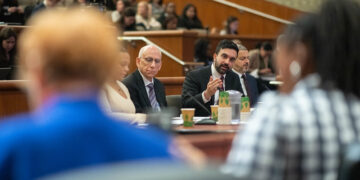
Furthermore, the focus on heavy subway policing will likely be a flashpoint in hearings. Progressives will argue that the $77 million could be better spent on subway maintenance or mental health response teams that do not involve police. But Governor Hochul has laid her cards on the table, betting that the majority of New Yorkers prioritize safety, stability, and a “steady hand” over radical change. Whether the legislature or Mayor Mamdani agrees remains to be seen.