


















































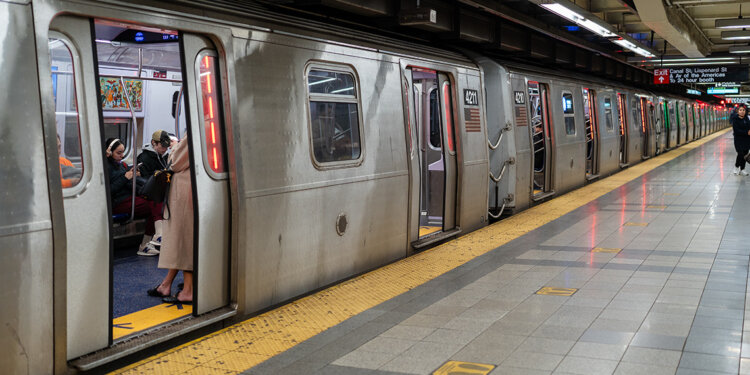
New York Governor Kathy Hochul vetoed a bill passed overwhelmingly by the state legislature that would have required every subway train in New York City to operate with two crew members, a driver and a conductor at all times. The decision has stirred sharp debate among transit workers, riders, budget watchdogs and policymakers about safety, cost and the future of one of the city’s most essential systems.
The bill, A4873/S4091, was rooted in a long running effort by the Transport Workers Union (TWU) and allied legislators to codify staffing standards that would guarantee two trained personnel aboard every subway train. In New York City, most trains already operate with a conductor and an operator under collective bargaining agreements, except on certain shorter lines like the Times Square shuttle or during limited one-person train operations on a handful of routes. The union argued that two crew members improve safety by allowing one person to monitor boarding and platform conditions while another operates the train.
Supporters also framed the bill as a protection for blue collar jobs in an era when transit authorities around the world are reducing staff in favor of one-person operation or automation. TWU President John Samuelsen, a longtime advocate of the measure, called the veto “classist” and warned that it could fuel discontent among transit workers ahead of the next election.
The history of this legislation reflects deep tensions over how to run the nation’s largest subway system in a way that balances safety, cost and adaptability. Similar proposals have surfaced repeatedly in Albany, with labor leaders pushing back against what they see as relentless pressure to do more with fewer workers, and critics questioning whether a blanket staffing rule is necessary in the first place.
Governor Hochul rejected the measure primarily on fiscal and operational grounds. In her veto memo, she argued that mandating two-person crews on every train would cost the Metropolitan Transportation Authority up to $10 million annually, potentially reducing service and limiting investment in modern signaling and rolling stock. Hochul’s office pointed to research showing that the vast majority of subway and commuter rail systems worldwide operate with one person or automated controls, and that the extra staffing requirement could constrain the MTA’s flexibility to modernize its operations.
Budget watchdogs and civic groups such as the Citizens Budget Commission and the Regional Plan Association praised the veto, saying it allows the MTA to adopt more efficient practices and invest scarce dollars where they can benefit riders most. A statement from several organizations called the two-person mandate a constraint that would have “raised MTA operating costs and limited the agency’s ability to implement modern operating methods.”
But the veto does not resolve the underlying debate over subway staffing. Transit workers argue that two people aboard a train enhance situational awareness and passenger assistance, particularly during emergencies or disruptions when crowd control and communication are critical. Riders, too, remain divided. Some feel safer knowing more staff are present, while others view the proposal as an unnecessary labor protection at the expense of the system’s financial health.
In practical terms, the veto means that the status quo, governed by existing union contracts rather than state law, will continue. Most trains will still operate with two crew members, but the MTA retains the ability to determine staffing based on operational needs, budget constraints and evolving technologies. With subway ridership climbing and safety improvements underway, the governor’s decision underscores a larger question facing New York’s transit system: how to deliver safe, reliable service while adapting to technological change and financial realities.
In the weeks and months ahead, lawmakers could attempt to override the veto or pursue alternative legislation. For now, the debate over one-person versus two-person crews will continue to resonate with riders, workers and leaders grappling with how best to sustain the lifeblood of the city’s daily commute.